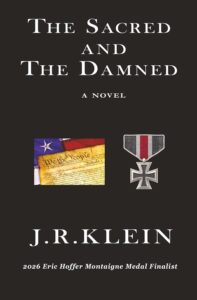
By: J.R. Klein
Publisher: Del Gato
Publication Date: September 22, 2025
ISBN: 979-8992384161
Reviewed by: Douglas C. MacLeod, Jr.
Review Date: September 2, 2026
Stories about good versus evil stand the test of time, because (unfortunately) where there is good, which is a known constant, evil is always bound to exist. Of course, perceptions of what makes something or someone good or evil is in the eye of the beholder; as Ray Bradbury wrote in his novel Something Wicked This Way Comes: “Good to evil seems evil.” But, as it pertains to the common world order, where ambiguity is not even close to being a possibility, most can recognize when authentic injustices or wrongs are taking place against another. J.R. Klein’s jarring new work of fiction, The Sacred and the Damned, is a stark and powerful reflection of that truth, taking place in the halls and dorm rooms of a privileged New England university.
Aspiring writer Nicholas Schefield is a first-year student at Bradford University, a liberal-minded institution that seemingly prides itself on its diversity and its prestige. As is written: “The university shared a level of reverence with schools such as Harvard, Yale, and Princeton.” Nicholas (or Nick, as he likes to be called) is the son of a rich widower who owns “an elegant house” which is occupied by only his father, “a housekeeper and a cook;” thus, it is established early on, in unpretentious first-person, that his father can afford to send him to such an elite college due to Nick’s family’s economic status. Soon after, without much in the way of exposition, Nick is cornered in his claustrophobic dorm room by his antagonistic foil and overt future nemesis, Krause Wilhelm Lunz, a conspiratorial fascist who clearly would rather be a cynical and biased gadfly than a rule-abiding student and upstanding citizen.
The tone of the novel is set early on that Lunz is going to be nuisance to Nick, the binary to Nick’s wholesomeness and moderate ways of thinking. Throughout, Lunz speaks to Nick about his sexual exploits with female students, his disdain for the faculty and classes he does not attend, his unsympathetic and unempathetic views on political hot-button topics, and his co-creation of the National Peoples Party (NPP), an extremist group with a manifesto called Unser Kampf, which claims America is weak and “a hoax,” and that White people “are the true victims of slavery.” According to Unser Kampf, the government should have no power; instead, it is the American people who should revolt against “greedy politicians [who] make promises that they know they will never keep.”
Schefield and Lunz’s respective stories and ideologies, thus, become the central focus of The Sacred and the Damned; however, Nick’s voice is the one we follow. Through Nick’s eyes, readers experience the rise and eventual fall of Lunz, who is the physical embodiment of fascism. Nick finds love with an African American girl, Monique Dubois, and is periodically writing a novel, using his college experiences as fodder to author his own fictional narrative. However, these extended side-stories, which also include the untimely death of his father, are important to Nick’s growth as a character, but are incidentals to the primary plot point, which is Right-wing extremism can manifest itself anywhere and is dangerous no matter where or when it comes about.
Like fascism, Lunz disappears for days and weeks on end, but then shows up at Nick’s front door, ready to spew racist and sexist politics at the drop of a hat while invading “the solitude of [Nick’s] mind.” He becomes the mouthpiece for NPP member and Alabama Congressman Horace Crockett, who manages to win his election and travels around the country to vomit out his discriminatory rhetoric. Also, like fascism, Lunz and the NPP are opportunistic. Later in the story, Lunz speaks about a congressperson from Wyoming who died after a horse-riding accident and how the NPP is on-the-ready to slither into the slot, to allow for fascism to grow within America’s politics. Lunz, in other words, is a mirror to what is happening in the United States, and in a variety of other countries around the globe: a rise of populism due to an underinformed constituency that votes more based on personal biases rather than sound policy decisions.
These representations of character make The Sacred and the Damned a strong piece of writing; and make Klein an effective novelist as a whole. Klein’s novel, through his use of narrative, is a sobering treatise on what we need to do to ensure extremism, which is a stain on all powerful institutions, loses footing on the global stage: it is up to us.
Quill says: In The Sacred and the Damned, Klein, through characterization, successfully shows readers who they are and who they could be become if not careful.
For more information about The Sacred and the Damned, please visit the author's website at: johnrklein.com/