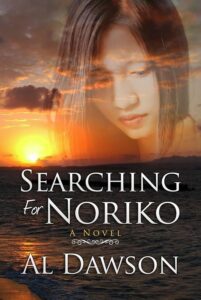
Franscico (“Frankie”) Castillo has trouble sleeping. His marriage is falling apart, and he mentally cannot step away from his sordid past as a World War II soldier. Readers are aware of a secret early on in Searching for Noriko, Al Dawson’s novel, but Frankie’s wife is unknowledgeable about his dilemma.
Along with his crippling PTSD and nagging leg injury, Frankie feels guilty about leaving war-torn Japan and his love-interest Noriko, a woman whom he deeply cared for, soon after the fighting ended and Japan proceeded to heal and rebuild. He got sent home, married the woman he was dating while in the States, had a child named Ellen, and built his own successful company, despite the insurmountable odds and circumstances of his life. Yet, Frankie still has this figurative gaping wound; and, the only way to operate on it is to go to his old haunts to find Noriko and to apologize for his unexpected departure. This decision leads to events that add to a complex, but easy-to-follow narrative with multiple characters (including Kume, Frankie’s other daughter), who come together for an explosive ending.
Searching for Noriko is very well-constructed with developed characters, each of which have a distinct voice and a stake in Frankie’s situation. Frankie decides to fly to Japan with Ellen to find his former paramour, and Kume decides she wants to know more about her natural father. These actions lead to the eventual meeting of all of the players, two metaphorical trains running parallel that collide with force during the novel’s climax of the novel. Admittedly, some moments are far-fetched—a plot point devoted to the Japanese mafia’s need to find hidden gold, the love affair between Ellen and an obnoxious environmental lawyer, and the coincidental meeting at the end—however, Dawson makes what seems unfeasible, feasible, and in less capable hands, it could have been disastrous. Dawson understands pacing and purpose; and, with each detail, context is implicitly and explicitly stated to ensure readers are not burdened with not knowing why, or with information not pertinent to the story.
Also impressive is Dawson’s knowledge of Japanese and World War II history. Not much of the story takes place during the War, but when added, it is done so with intent so as not to divulge too much of what is going to happen throughout the novel, nor to Frankie if and when he finds Noriko. Most compelling is his relationship with his wife, Melanie, who is in the dark as to what is happening to her husband, a man who always seemed tortured despite his full life. Lost a bit is his relationship with his brother and mother, who are on the peripherals, ghosts of a past that molded him into a tragic but redeemable figure. Dawson though, through his prose, is careful as he makes it known that we all are a sum of our parts. Who we are is based on the people who surround us and the places we come from, and readers can impressively see that through Frankie’s eyes and memories.
World War II was not the only life-altering event discussed in Searching for Noriko. Minimally mentioned is 9/11; and, much of the book takes place in late 2001 and 2002, in New York. While in Manhattan, Kume and her significant other, Gary, nonchalantly travel around as if nothing happened. They take cab rides. They eat dinners. They talk about an impending fashion show. They jump on planes without second thought. Mundane things in a city that never sleeps. But there are no discussions about the Twin Towers, about the death and destruction that took place on September 11th. This terror attack stopped the world for months after it happened, and yet these people are oblivious to this tragedy. Dawson, in essence, could have alluded to the heartbreak in a more significant way without stealing away from the narrative.
Quill says: Searching for Noriko is a compelling piece of historical fiction about family dynamics and the power of respect in love, filled with good storytelling and strong details about Japan during and after World War II.
For more information about Searching for Noriko, please visit the author's website at: lunadellobo.com/
Author Interview