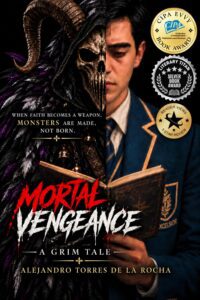
Alejandro Torres De la Rocha's Mortal Vengeance: A Grim Tale (Prequel to Mortal Vengeance) is a story about how a corrupt, abusive school created its own monster, a monster that preys on the guilty, specifically those who commit cruelty and then hide behind power, faith, and silence. The story's dedication: "To all those who fear raising their voice. Speak up. Speak out. Speak truth" is the voice of the entire novel, and a warning wrapped in a welcome. It asks the reader to read every "welcome" as a potential trap, because in this book, hospitality always comes with a catch.
The book opens with a suffocating silence, a clock counting down, and a beauty that Julián Díaz sees as a mockery. He's carrying a crushing weight: guilt, the kind that defies logic and innocence. He's done nothing to earn it, yet believes he's stained. It's also the kind that Grim Cojuelo, the monster and a figure torn from Dominican carnival myth, loves to harvest. But he's not your conventional monster. His prey's death doesn't stop him, meaning there's no escape for them, even in death. He also first offers flashes of a twisted heaven before dragging his victims straight to hell. He doesn't overpower them but outsmarts them, making them walk into their own damnation while they believe they are walking into salvation. That's precisely why he is insidious.
This book captures the monster's becoming process and aftermath, and it does so through the concept of performance. The school performs holiness, the priests perform mercy, and the students perform obedience. "Performance" here is the right grounding because it names the gap between the front and the backstage: the assembly's polished piety and the abuse happening behind closed doors. The Acts and Scenes structure makes this literal. Each one of them is a moment the reader watches, knowing the backstage truth the performers can't admit. Admitting would, of course, end the play. So, the book forces them to withhold until the monster tears the last curtain down.
That's the mark of a book that knows exactly what it's doing: building an argument the reader absorbs through the structure itself. By coupling that with short, stripped sentences like "Julián screams. It is a raw, primal sound ripped from his throat, echoing in the cavernous space. He doesn't think. He doesn't hesitate. He just bolts," the novel manages to immerse the reader into the immediacy of the moment, even as the performance thins, before again picking the ritual and letting the withholding resume. Few authors manage that. Alejandro Torres De la Rocha makes it look easy. But the ease is the scary part. He performs the same trick on the readers as his villains do, only he does it better, giving them enough to keep them reading but never quite enough to make them relax.
Quill says: Mortal Vengeance: A Grim Tale (Prequel to Mortal Vengeance) is dense in the best way: idea-rich, not wordy. It's easy to read, thanks to its short sentences, natural dialogue, and a propulsive plot. It's also well written, begging for a second reading, particularly because once you know how it ends, every earlier scene changes.
For more information about Mortal Vengeance: A Grim Tale (Prequel to Mortal Vengeance), please visit the author's website at: mortalvengeance.com/