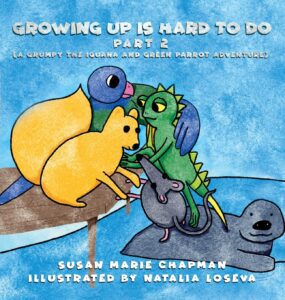
Growing Up Is Hard To Do Part 2 is an interesting and educational picture book that revolves around four friends: Grumpy the Iguana, Green Parrot, Mr. Squirrel, and Little Mouse.
The story follows the friends' adventure after meeting a mysterious animal in the water. They had never seen anything like it. Initially, they are confused and frightened by the unfamiliar creature, but gradually the small group of friends learn about and become friends with Baby, a young manatee. At first, they mistake her for a whale but with time they come to realize that although Baby looks scary, she is actually quite a gentle soul.
Excited to have made some new friends, the young manatee invites all four of them on a tour of the marina where they experience the colorful and thriving underwater world together. Then something unexpected happens, as they encounter a passing motorboat and suddenly notice how certain areas where the manatees live are marked as “No Wake Zones.” They learn that boats need to slow down while passing through these places to avoid harming any of the animals living there. Towards the end of the story, their new friend, Baby, returns to the depths of the water to reunite with her mother, after promising to meet them again.
It is very important to note how instead of presenting information about the manatees in the form of a conventional lesson, the narrative blends facts naturally within characters’ conversations. Children reading this book eventually learn that manatees are herbivores, that they are mammals rather than fish, that they breathe through their lungs, and that they are an endangered species, hence requiring protection from motor boats. This makes the educational content more engaging for young readers, thereby a lot easier to absorb. The story also inspires children to become more attentive to endangered animals and the ways in which human activity affects wildlife in general.
However, the adventure itself remains relatively simple and a stronger plot with a more convincing problem or moment of conflict would have perhaps given the narrative greater momentum and made the final resolution more satisfying. The title also suggests a broader theme of growing, learning and becoming more independent, whereas the story focuses mainly on friendship, courage, animal awareness and environmental education. A clearer connection between the title and the characters' emotional growth could substantially contribute to the thematic coherence of the story.
Nevertheless, the book succeeds in its primary objective of educating young readers about a vulnerable species and encouraging them to become more environmentally conscious. The decision to center the educational material around an empathetic storyline about an unusual friendship between different animals is particularly effective, because it transforms abstract environmental information into something emotionally meaningful. The author gives us an entertaining adventure that not only renders the learning process enjoyable, but also makes crucial knowledge more accessible to children.
Quill says: Growing Up Is Hard To Do Part 2 is a warm and beautiful story that serves as a gentle reminder that learning about the world around us is the first step towards caring for it.
For more information about Growing Up Is Hard To Do Part 2, please visit the author's website at at: susanmariechapman.com/books/p/growing-up-is-hard-to-do-part-2