
Today, Feathered Quill reviewer Alma Boucher is talking with N.J. Schrock, author of Morning of a Crescent Moon.
FQ: Morning of a Crescent Moon is a deeply reflective and introspective novel. What inspired you to write the story?
SCHROCK: I grew up in Virden, Illinois, and my grandfather and father worked at the coal mine where the Battle of Virden took place. I was familiar with the history of what happened in 1898, when the coal mine operator planned to bring in cheaper labor—Black miners from Alabama. Also, I worked for twenty-five years at a large corporation and held a management role, serving on business and product development teams. I saw the pressure on businesses to maximize profits by keeping costs low. One way to do that is to keep employee wages and benefits low. Especially in the early 2000s, expansion into India and China was, in part, driven by lower labor costs, which led to job losses in the U.S. and Europe. I could see history repeating, and I felt there were lessons to be learned from the Battle of Virden. I wanted to broaden the public awareness of this historic event.

FQ: Identity and self-discovery play central roles in the narrative. How did you approach portraying such an internal and personal journey on the page?
SCHROCK: I put myself into Virden, Illinois, in 1898. One way I did that was by reading the Local News in the two Virden newspapers. I learned about what the townspeople were doing, their goings and comings, their marriages and deaths, the places they shopped, and so on. I read about a recipe party for two young women, and then in subsequent issues, I read with interest the details of their weddings. A woman discovered a tarantula in the bananas at Lorton’s grocery store. Imagine how shocked an Illinois woman would be to see a tarantula crawl out of bananas! I was shocked reading about it. Band concerts were held every Saturday night, and I know what was played. I was surprised by how invested I became in the lives of these people who lived more than 125 years ago. In writing this novel, I tried to reflect my connection to this time and place into the characters. Also, my editors helped me identify where to clarify the characters’ emotions so that readers could make the same emotional connection that I felt.
As an aside, I became so invested in the lives of those who lived in Virden in 1898 that I’m now on a mission to have the town’s newspapers digitized so that all this history is not lost and is more accessible.
FQ: Faith and belief are explored with sensitivity and nuance. What challenges did you face in writing about these themes, and how did you ensure balance and authenticity?
SCHROCK: This was the Victorian era, and a high standard of moral conduct was the ideal. The town had several churches. The newspapers published service times, which were twice a week, Sunday mornings and Thursday evenings, and they frequently listed who was preaching and on what topic. Many social activities centered around the church. But the purpose of my writing Morning of a Crescent Moon wasn’t to proselytize or explore Christian themes. I tried to portray how religion was a part of the characters’ lives. As a practicing Christian myself, I know that faith can wax and wane, so I included Cate’s questioning or “wrestling” with God, particularly in the funeral scene in Chapter 21. When the preacher quotes the Bible, “God shall wipe away all tears from their eyes; and there shall be no more death …” Cate wonders, “If God was going to do that, why not do it now? Why wait?” I felt that, to be true to the period, Christian faith had to be part of their lives, and that, to be authentic, it had to be accompanied by doubt or questioning.
FQ: The novel places strong emphasis on quiet moments rather than dramatic action. Why was this storytelling approach important to you?
SCHROCK: Most of life happens in the quiet moments. The main characters are a schoolteacher and an unemployed coal miner. Their lives would not have been edge-of-your-seat excitement. But they were important, evolving in their quiet, steady ways until called upon to take a stand and play their parts in a historic event.
FQ: The title is evocative and symbolic. Can you share its significance and how it connects to the themes of the book?
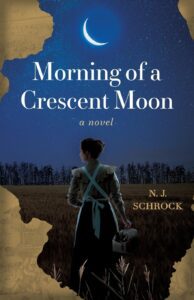
SCHROCK: On the morning of the Battle of Virden, October 12, 1898, the skies were clear, according to The Virden Record, and a waning crescent moon would have been rising in the east, according to lunar calendars. A crescent moon appears before and after a new moon and is associated with new beginnings. The main characters note the rising crescent moon, and although they don’t know how the day will unfold, they know that history will be made and that they and the town will be changed by the events. One way or another, that day would be a new beginning for them. And, historically, the Battle of Virden was a new beginning. It was a turning point for the United Mine Workers and served as an example for other labor activism.
FQ: Your prose is lyrical and atmospheric. How would you describe your writing process, and do you focus more on character, theme, or language when drafting?
SCHROCK: As a trained scientist, I find that my first draft is rather dry. I’m trying to determine the action and what will happen. What would these characters be saying and doing? In subsequent drafts, I add sensory details that help readers experience the scenes. I have to credit one of my editors, Deborah Froese, with encouraging me to make the aeronaut scenes more lyrical. Both Deborah and Terra King, my line editor, encouraged me to add more emotional connection to characters in a few critical scenes. These additions, no doubt, strengthen the writing.
Regarding lyrical writing, I love Ray Bradbury’s book Zen in the Art of Writing. Bradbury is a great lyrical writer. In the chapter “How to Keep and Feed a Muse,” he says, “Read poetry every day of your life.” I confess that I don’t read poetry every day, but I do read and appreciate lyrical poetry. My favorite quote of Bradbury’s from Zen may be this one: “We never sit anything out. We are cups, constantly and quietly being filled. The trick is, knowing how to tip ourselves over and let the beautiful stuff out.” I hope my writing does that.
FQ: The characters feel authentic and emotionally grounded. Were any of them inspired by real-life experiences or people?
SCHROCK: Yes, they were. Cate’s Aunt Alice is based on my grandmother, Mary, including this line she has in Chapter 1: “… the only place you’ll find sympathy right now is in the dictionary, not from me.” Harry is based on my father. Demand for coal was less during the summer months, and coal miners could be out of work for weeks at a time. Many of them, like my grandfather, grew summer gardens, for a garden was an important source of food. And they grew enough to sell and to can the vegetables, as Noah does, for the winter. My father grew up during the Depression, and he pulled his wagon around town, selling vegetables. And like Harry in Chapter 1, he said that one time he rang and rang a woman’s doorbell, and she came to the door quite annoyed with him. Some of Cate’s teaching was based on my first-grade teacher, Miss Minnie Vietti.
FQ: The pacing of the novel is measured and intentional. How do you determine the rhythm of a story like this, where emotional growth drives the plot?
SCHROCK: I began with a timeline that specified what had to happen when for historical accuracy. I noted dates from the newspapers, such as when school started, when the Illinois State Fair took place, when the woman found the spider in the bananas, and other events that actually occurred. There was always something going on, and if there wasn’t, then I invented something that could have gone on, such as a quilting bee. I also had events that had to be inserted in the right place to keep revealing to the reader what was driving Cate, such as her flashback to her time as a nurse and being molested one night. I tried to ensure that every chapter advanced the plot and developed the characters. Our life experiences change us, and so they changed the characters in this story.
FQ: Did writing this novel change your own perspective on any of the themes explored in the book?
SCHROCK: One of the themes in the book is strength in unity. If workers unite, they can succeed in demanding a living wage and safer working conditions. What I didn’t appreciate was how many out-of-town miners actually showed up to support the Virden miners. Hundreds, and by some estimates thousands, were on hand by October 12 to prevent the mine operator from bringing in workers from Alabama. I also didn’t realize how other mine operators had succeeded in importing cheap labor and how Virden was a critical turning point for stopping what could have become a downward spiral in wages. They were trying to prevent the type of poverty that was common in West Virginia and Pennsylvania mining towns, for example.
Another theme was that these were hardworking people striving to build better lives for themselves. I didn’t realize going into the research how similar some things were. I gained an appreciation for how modern this society was, even though there were also major differences. In 1898, they weren’t driving cars. The roads were dirt. The FDA didn’t exist, so ads for “cure-all” medicines were common. But one similarity to today is that people who could afford to travel were traveling across the country. They traveled by train to the East Coast, Colorado, California, and Texas for vacation. I did not have a clear picture of what this society would be like until I spent time reading the newspapers.
Writing this novel helped me to appreciate the power of historical fiction if written true to the era. I recently posted a blog on “Why Historical Fiction?” It’s not a theme in the book, but it’s a perspective of mine that shifted as a result of writing the novel. https://njschrock.com/2026/01/13/why-historical-fiction/
FQ: What do you hope readers take away from Morning of a Crescent Moon after turning the final page?
SCHROCK: In Chapter 22, a coal miner and a leader in the 1897 strike, Alexander Bradley, gives a speech that I wrote based on his memoir and newspaper accounts of what he told the miners during the 1897 strike. He clarifies for a Virden crowd what the stakes are in their fight: “The battle for workers’ rights, the right to exercise the only power we have, which is the right to organize, will be under threat—again—and again—and again. It’ll be fought in a thousand places: in coal fields, in factories, in railways, in dockyards, and anywhere workers are not paid the living wages they deserve for pouring the hours of their lives into their labors….”
I hope that readers will come to appreciate the sacrifices made by those who came before us and that in some industries, we still face many of the same challenges they faced in 1898.
The responsibility is now on us to “carry the torch” and work to make this country a place where we want to live. That’s what these miners were fighting for.
Change can be driven by typically quiet, unassuming, hard-working people if they unify and take a stand for what they believe.

Disclosure in Accordance with FTC Guidelines 16 CFR Part 255
Copyrights © 2023 Feathered Quill Reviews All Rights Reserved. | Designed & Developed by Unglitch.io