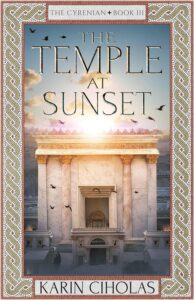
Today, Feathered Quill reviewer Alma Boucher is talking with Karin Ciholas, author of The Temple at Sunset (The Cyrenian Trilogy Book 3).
FQ: Why did you explore faith and family conflict at The Temple at Sunset?
CIHOLAS: Simon is deeply serious about God and proud of his Jewish heritage. He fights for justice for his fellow Jews, sets up demanding goals for himself, and expects his children and wife to follow. When their actions collide with his realities and faith, he suffers because he is deeply committed to his Jewish faith. He also fears for his family's safety and has good reasons to fear. As a physician, he is a compassionate man who wants above all to heal.
FQ: How was Simon’s emotional journey developed?
CIHOLAS: Simon lives in a world he cannot control. Rome controls. Religious demands control. The rich and powerful control. Our world is not that different today. Simon strives to be the best physician in the empire, but he must face the reality that the art of medicine is difficult and often fails him. As he is brought to his knees, he is humbled and cries out to the universe. His emotional journey leads to deeper revelation.
FQ: Aurelia’s Christianity is central to the story. What drew you to write about early Christianity?
CIHOLAS: Christianity almost didn’t happen. John the Baptist, the main prophet, was beheaded. Jesus was crucified. Almost all the disciples were martyred. Leaders and followers were put to death. It took almost a generation for the new faith to be called Christianity. It took even longer for the first gospels to be written. The period between the crucifixion and the fall of Jerusalem changed the world. It is one of the most fascinating and exciting periods of history.
FQ: Why was Liora’s feeling of invisibility important to include?
CIHOLAS: It was typical of the times that women didn’t play major roles. Even as a child Liora senses how wrong this is and asserts herself in the only way she can. But it takes Simon years to realize how closely he came to losing her. Finally contrite, he admits he has a lot to learn from her. I also believe Aurelia set the example. She is stronger than Simon in so many ways.
FQ: How did you balance historical context with intimate family dynamics?
CIHOLAS: The history and the personalities of the major characters came together naturally. Intimate family dynamics don’t change much over time. The historical settings do.
FQ: Were there scenes in the novel that were difficult to write emotionally?
CIHOLAS: The scenes that were the hardest to write: the trial of Paul, the martyrdom of early Christians, the war, and the loss of the temple. These are counterbalanced by fun stories to tell about magic potions, Vespasian’s down-to-earth peasant personality, and Liora’s clever manipulation of her father.
FQ: How do you hope readers will interpret Simon’s losses and his internal struggle?
CIHOLAS: I hope readers will believe in the characters as real human beings who lived and suffered and made mistakes. I hope readers are encouraged by Simon's endurance and tenacity. He never loses sight of his mission of healing.
FQ: Did your view of belief evolve while writing this novel?
CIHOLAS: I already had a profound interest in Judaism. I gained more respect for Judaism as the grounding for my Christian beliefs after studying ancient accounts. In that way, my beliefs evolved. I also gained more insights into the incredible advances in science and technology and the role the Museion played in Alexandria for research in medicine and the sciences. I read a lot of books on ancient Egyptian medicine and immersed myself in the writings of Hippocrates and of other ancient physicians. All the research—over many years—was a lot of fun. Alexandria was the fascinating intellectual hub of the Roman empire. Its heart was the greatest library of antiquity.
FQ: How much historical research informed the spiritual elements of the book?
CIHOLAS: I grew up around theologians discussing everything from textual criticism to the history of the sacraments. But intellectual interest is not necessarily a spiritual journey. The spiritual aspect of religion for me comes from the experience of awe I feel when I look at the night sky. It's when I ask the bigger questions of who we are. I see Simon in the light of his spiritual quest. In my research, I reread the scriptures, seeking to see things from Simon's point of view. I tried to read the old stories as though I had never heard of them before. I gained a whole new respect for Judaism and for the Jewish religion and realize how much I, as a Christian, am indebted to Judaism. I seek to honor the deep heritage that was also the heritage of Jesus.
FQ: What conversations do you hope this novel will spark among readers?
CIHOLAS: How is healing connected to what we believe? Which character did you want to meet in person if any? Did you get upset with Simon? What did you think about Tiberius Alexander? He is the most powerful Jew in the book and became Prefect of Egypt, a position second only to the emperor. I didn’t make him up. He is historical. Those who have read the first two books in the trilogy met him when he was an obnoxious upstart and a bully. Simon dismissed him as “more Roman than a Roman.
We talk about the rich Judeo-Christian tradition that western society is built on. Is that still true? Has the meaning of that changed? Are we still greatly influenced by that tradition?
Read the Review