
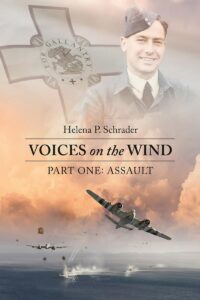
Today, Feathered Quill reviewer Alma Boucher is talking with Helena P. Schrader, author of Voices on the Wind — Assault: A Novel of Malta in WWII.
FQ: What inspired you to write a novel centered on Malta during World War II?
SCHRADER: The story itself. You can't make something like this up. Literally, more bombs fell on an island one-fifth the size of Los Angeles than on all of Germany in 1942. In April 1942 alone, more bombs rained down on Malta than in the entire Blitz of London -- which was three times larger! On top of that, the island was slowly starving to death. Yet the Maltese didn't surrender and they didn't wallow in self-pity. They kept fighting, and won.
In a way, Malta was a microcosm of Britain itself; Britain too was dependent on imports carried by ships -- simply at a far larger scale. The Germans came close to choking off Britain's lifeline too, but the Battle of the Atlantic raged over five years, while the crisis on Malta came in eight months. The combination of a massive air offensive and a near successful siege make the story of Malta in 1942 especially dramatic and so uniquely suitable for fiction.
FQ: Malta itself feels like a character in the story. Was that your intention from the beginning?
SCHRADER: Not really. Malta is fascinating, unique and indomitable. It's a tiny island with a history that reaches back before the age of the Pyramids in Egypt. It was conquered and settled by Phoenicians, Greeks, Romans, Arabs, Normans, and finally Napoleon himself! In 1565, it withstood a massive siege by an Ottoman seaborne army and a tiny force of defenders led by the Knights of St John (one of my favorite militant orders) emerged victorious. What followed was a period of artistic and architectural flourishing that is unique in the Mediterranean and left a magnificent legacy. Yet the Knights of St John became decadent and corrupt. They were swept aside by Napoleon only for the Maltese people to rise up in rebellion and defeat the French in weeks -- with a little help from Admiral Lord Nelson! The people invited the British in -- but issued a Declaration of Rights that articulated limits to British rule. The next century and a half was one of mostly symbiotic relations between the Maltese and the British. In addition, Malta played a important role in both World Wars. You can't ignore -- or invent -- a character like that.

FQ: The novel portrays both military and civilian experiences. Why was it important to include multiple perspectives?
SCHRADER: Because there are so many perspectives. I would argue that is true of nearly every historical event. All my novels include multiple perspectives and story lines. I detest books written in the first person. It's like filming a movie with only a single, handheld camera.
FQ: Were there any real-life accounts or personal stories that particularly influenced the narrative?
SCHRADER: I relied heavily on the wonderful memoir by Charles Grech, a native of Malta, who lived through the war as a youth, Raiders Passed: Wartime Recollections of a Maltese Youngster. I loved Paul McDonald's tribute to Christina Ratcliffe and other women who lived through this crisis in Ladies of Lascaris: Christina Ratcliffe and the Forgotten Heroes of Malta's War. Another important source was Wing Commander T.E. Neil's Onward to Malta and Angus Mansfield's "I Wish I Had Your Wings: A Spitfire Pilot and Operation Pedestal, Malta 1942." Another gem is Frank Leighton's memoir, Frayed Lifelines: A Siege Survivor's Story, which depicts life on Malta in this period from the perspective of an ordinary 'erk' (aircraftman) working with the Air/Sea Rescue unit; very detailed right down the color and design of ration cards. No heroics whatsoever! And since nothing is better than a novel for evoking a society, I must mention Nicholas Monsarrat's The Kappillan of Malta.
For the maritime story line, I relied heavily on The Quiet Heroes by Bernard Edwards and At All Costs by Sam Moses. These books don't single out any specific 'hero' or character, but they provide a wealth of information on what it was like manning merchant ships in WWII.
FQ: What was the most surprising fact you discovered about Malta during your research?
SCHRADER: Although I suspected that Malta was an 'intelligence hub' simply due to its proximity to Sicily, I was astonished to discover that the only X-machine for deciphering German enigma messages located outside of the British Isles was installed in the British HQ bunker at Lascaris.
Because of the high levels of classification, the Official Secrets Act, and wartime training, we know far less about intelligence operations than other kinds of operations. While the release of F.W. Winterbotham's book The Ultra Secret made "Ultra" and "Enigma" household words and the role of Bletchley Park has become famous since, these are only part of the story. Malta's role in intelligence was first hidden, and has now largely been forgotten. Historians appear not to have fully explored it. We do know, however, that at least one WAAF was assigned to Intelligence on the island. So Candice is not implausible.
FQ: How do the characters reflect the resilience and determination of the Maltese people?
SCHRADER: Malta didn't surrender. The Maltese didn't rebel against British rule. They didn't offer passive resistance. They didn't scrawl graffiti on the ruins demanding British withdrawal. The Maltese manned the anti-aircraft batteries, they served in the RAF and RN. Maltese women were plotters and Y-Service operators. Maltese health care professionals ran and manned the hospitals. Malta was not simply a base for action; Malta was a participant. As my novel suggests, morale was worse in the RAF than among the civilian population.
FQ: What role does hope play in sustaining your characters through the hardships they face?
SCHRADER: That's really more for you to judge as a reader. Robin certainly is not hopeful about the situation! He's a cynical realist. Ned is far more focused on his own role than the overall situation. Stevie states baldly that the Admiralty cannot afford to sustain the losses incurred by supplying Malta and suggests they will abandon it 'soon'. (But, of course, in this volume he has not yet become directly involved in the situation in the Mediterranean and has no direct insights.) Candice is simply struggling to do her job and not disgrace herself in her own eyes -- and falling in love, of course.
FQ: How important was it for you to highlight the sacrifices made by the people of Malta?
SCHRADER: It's the very least we can do. The Second World War was not a "war of choice," or a war of domination, much less an aggressive war on the part of the Allies. Malta's role was critical to Allied victory, and as such we all owe a debt to the Maltese as we do the veterans of the war the world over.
FQ: Why do you think Malta's wartime story remains relevant today?
SCHRADER: I believe that we can best understand ourselves by understanding the past. The assault and siege of Malta doesn't have a one-to-one relevance with anything happening today -- although one reader said she felt like she was reading about Gaza, and another reader said they thought of Ukraine. The main point is simply that this novel is based on real events. Most of what I describe really happened. This isn't fantasy. It isn't dystopian or alternative fiction. The broad events depicted happened and understanding how people cope in such situations should be an inspiration to us all.
FQ: If readers could take away one message from Voices on the Wind — Assault: A Novel of Malta in WWII, what would it be?
SCHRADER: When fighting tyranny, you don't calculate the chances of success or fight because you expect to win; you fight because you define yourself by your opposition to evil.
Thank you for the lovely review and the opportunity to answer a few questions.

Disclosure in Accordance with FTC Guidelines 16 CFR Part 255
Copyrights © 2023 Feathered Quill Reviews All Rights Reserved. | Designed & Developed by Unglitch.io