
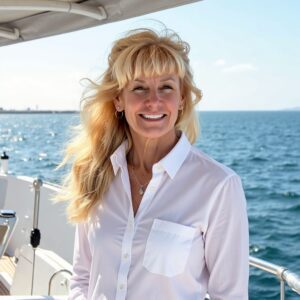
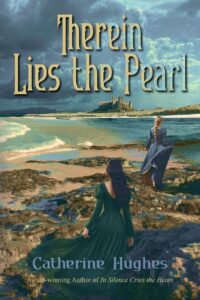
Today, Feathered Quill reviewer Nellie Calanni is talking with Catherine Hughes, author of Therein Lies the Pearl.
FQ: What drew you to the relationship between Celia Campion and Margaret of Scotland? How much of their interaction is based on historical record versus your own creative interpretation?
HUGHES: It may sound rather odd, but the novel originated not with a pair of female protagonists but only with one--Margaret. After visiting Edinburgh castle and walking up the narrow stone path to St. Margaret’s Chapel, I knew I wanted to write a novel that featured this amazing woman who had changed the course of history. However, virtuous people (like Margaret) can sometimes be a bit boring--from a reader’s standpoint--so I needed to add a dynamic figure to counterbalance her piety. Thus, the character of Celia Campion was born.
The feisty girl from Normandy is entirely fictitious; everything about her is creative interpretation. She moves amidst a backdrop of greater events swirling about Normandy during the years leading up to the Conquest: battles at Varaville and Val-es-Dunes, the surrender at Le Mans, the shipwreck and oath taking of Harold Godwinson, just to name a few. In contrast, many details in Margaret’s personal life can be verified through historical records. Her arrival in England, her father’s mysterious death, her schooling at Wilton Abbey, her acquaintance with Malcolm III--all are grounded in truth. I did place my own spin on how she would have framed each of these occurrences though, especially with regard to how she behaved, the words she said, and what she was thinking during those situations.
FQ: The title is evocative. Without giving too much away, how does the metaphor of the pearl evolve for both Celia and Margaret throughout their journey?
HUGHES: Turgot, in his 11th century biography Vita St. Margaritae Reginae, was the first to label Margaret as “the Pearl of Scotland.” He did so for two reasons: as a nod to the Greek derivative of her name and as a symbol of her purity. His word choice made me think more deeply about pearls and their formation. Such gems emerge only after the introduction of an irritant or parasite. The mollusk then goes to work, coating the alien substance with layers of nacre, essentially transforming pain into something beautiful. That is what Celia and Margaret do. Whether it be loss, betrayal, or death, the two women transmute adversity into opportunities for growth, wisdom, and understanding.
FQ: Most histories of the Norman Conquest focus on the battlefield. Why was it important for you to tell this story through the eyes of women navigating the political "undercurrents" rather than the soldiers?
HUGHES: From traditional sources, everybody knows of the events leading up to and including the Norman Conquest of 1066: the death of the childless king, the men fighting for the crown, the subsequent rebellions and invasions. But I wanted to examine the experience from the perspective of those left out of the history books. People whose voices had been ignored because they lacked influence, wealth, or fame.
A woman like Celia would never have been given a chance to speak in such chronicles--neither would Margaret for that matter. at least until she had achieved royal status. And that silence is tantalizing. Despite being on the periphery, they were impacted by all the decisions made by those in power. Through their eyes, readers get to feel the impact such catastrophic events had on the ordinary person, and that closeness makes for a deeply personal and intense experience. Telling history from the vantage point of those who are not the “movers and shakers” offers a more nuanced understanding of the past. Instead of being on the battlefield, for example, the reader gets to examine the Conquest from the vantage point of two women who are fighting just as bravely and just as tenaciously as the huscarls in the shield wall, only the women carve their destiny not with spears or swords but with internal reserves of determination and faith.
FQ: The setting feels incredibly lived-in. What was the most surprising or difficult piece of historical detail you had to research to make this world feel authentic to a modern reader?
HUGHES: One of the most challenging settings was that of Wilton Abbey. Historically, this was where Margaret and her sister Cristina were schooled, but I had to dig deep not to let this portion of the story lose momentum. The contemplative nature of the convent, along with its predictable daily schedule, could have made for tedious reading. To spice things up a bit, I decided to provide a cross-section of the various personalities of the nuns there, and that was great fun. But I still needed something more concrete, so after reading Writing the Wilton Women, I decided to contact a theology professor at U of Notre Dame to discover if its author, Goscelin, may have been at the Abbey at the same time as Margaret. I was thrilled when Professor Katie Bugyis emailed me to say that it was entirely plausible for him to have been there researching his book when she was in attendance. With Goscelin on the scene, I could add young Eve and Goscelin’s discovery of the miracles performed by St. Edith. And then of course, when “Sister” Celia eventually arrived at the Abbey to conduct her espionage, everything sped up even more.
FQ: When writing about real historical figures like Duke William or Edward the Exile, how do you balance the "set-in-stone" facts of history with the need for a compelling, fast-paced plot?
HUGHES: The two concepts do not necessarily have to be exclusive. In other words, the “set-in-stone” facts of history can be compelling as long as the writer approaches them as if the character himself were a living, breathing, sensitive human being with his own dreams, desires, fears, and opinions. Take Edward the Exile, for example. History tells us that he spent most of his life on the Continent. A native son who had no recollection of the country that was calling him home. From there, we can ask certain questions in order to humanize him. How shocked was he at being summoned to England? How nervous was he upon arrival? What was he wearing? Did he interact with the people? If so, how much did he prepare for his first speech to them? Did he feel welcome? Did he believe he made a positive impression? Was he suspicious of anyone? Did he foresee trouble ahead? And most importantly, how did he die? When you take historical facts and ask such intensely personal questions of them, the story becomes dynamic and engaging.
FQ: Can you tell us about your personal journey to becoming a published author? Was there a specific "spark" or a particular historical discovery that made you realize that you had stories to tell?
HUGHES: As a matter of fact, yes! There was a specific moment when I realized I had a story to tell. On a trip to Scotland back in 2019, I visited Urquhart castle and read the placard outside the prison cell that mentioned the name of its most famous prisoner, Domhnull Donn. Arrested for being a cattle reiver, Domhnull was eventually executed, not because he was a thief, but primarily because he was in love with the laird’s daughter.
In a very peculiar way, something clicked inside me, and the sensation reminded me of a comment Hilary Mantel once made about writing; “I like putting my hand out to the dead and seeing who will take it.” For some reason, Domhnull reached out and wouldn’t let me go. When I came back to NY, I started researching everything I could about cattle reiving, Urquhart, the surrounding region, and the courtship and fate of the two lovers. Over and over, I kept saying to myself, why hasn’t someone told their story? Once I started filling up marble notebooks, I began to realize that “someone” was going to be me! That was the spark that led to the publication of my first book, In Silence Cries the Heart.
FQ: How has your writing process changed from your first draft of this manuscript to the final version we see today?
HUGHES: There were a great many changes that occurred from the writing of the original manuscript to the final version of the book. One major adjustment involved the structuring of the chapters. At first, I was going back and forth between the two protagonists, a chapter for Celia, a chapter for Margaret. When the first draft was finished and I did a read-through, I thought, oh no! The experience was awful! I felt like a ping pong ball, bouncing back and forth, everything all herky-jerky; it made me feel so dizzy! So I scrapped that and strove for more consistency and fluidity, allowing each character to speak for longer periods of time. In addition, I eliminated certain portions--like one whole section when Philippe was a young boy--primarily because those sections were not enhancing or furthering the plot, and/or they were blurring the lens from which I wanted to tell the story.
FQ: For aspiring writers looking to tackle complex historical periods, what is the best piece of advice you received—or wish you had received—starting out?
HUGHES: First, choose a historical time period that enthralls you, one that appeals to you in such a way that researching it will feel invigorating and exciting. Second, remember that you are telling a story. Don’t be so detached from your material that it becomes a dry recitation of events that reads more like a textbook than an engaging tale. Lastly, write for yourself, not for the market or reviews. When you stay true to your voice and your decisions, the end result will be something of merit, something of which you can be most proud!
FQ: Are you planning to stay within the medieval era for your next project, or is there another "hidden" pocket of history you’re eager to explore?
HUGHES: The manuscript for book #3 is complete, and yes, it is very different from my two other novels in that it is set in America--Plymouth Colony in 1621, to be exact! When a second ship arrives from England with no provisions and 35 more mouths to feed, the New England settlement struggles for its very survival. Rachel Haverford, one of the passengers from the Fortune, finds herself marked as a “stranger” by the devout colonists and is soon forced to defend her innocence as accusations of witchcraft begin to swirl. Shadows lengthen and suspicions intensify as Rachel fights to clear her name and preserve her life.
Interestingly though, I travel back “across the pond” and return to the Medieval Period once again for book #4--which I’ve already begun researching. The setting is the double minster (monastery) at Streanaeshalch (later known as Whitby) in the 7th century under the direction of Abbess Hild. The story involves an unsolved murder, and one of its featured characters will be Caedmon, the first English poet. As I said, I’m still in the early stages of reading and researching, but this part of the writing process is just so captivating! I must force myself to establish and adhere to certain deadlines; otherwise, I’ll never stop immersing myself in yet another book, chronicle, article, map, or podcast!

Disclosure in Accordance with FTC Guidelines 16 CFR Part 255
Copyrights © 2023 Feathered Quill Reviews All Rights Reserved. | Designed & Developed by Unglitch.io