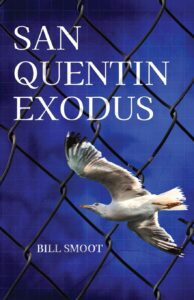
Today, Feathered Quill reviewer Katie Specht is talking with Bill Smoot, author of San Quentin Exodus.
FQ: Tell our readers a little about yourself. Your background, your interests, and how this led to writing a book?
SMOOT: I am a writer of short stories, novels, and essays. In the years I taught in the college program at San Quentin Prison, I always wondered--it was a kind of a thought experiment--how one might escape. When the pandemic hit, I begin to imagine a character who wondered about escape, who she might be helping to escape, and why. All the pieces fell into place.
FQ: Have you always enjoyed writing or is it something you’ve discovered recently?
SMOOT: I have always liked writing. When I was nine, I fell in love with a girl and wrote a story in which we traveled to the moon. In college, I was involved in student journalism, and that was a very important element of my coming of age. I was editor of the college newspaper, and the university president tried--and failed--to fire me. That taught me that writing is a way of pursuing truth. At some level, I feel I've always been a writer, even when I'm not writing.
Writing fulfills a variety of needs for me. One of them is making. I have always liked making things--cookies, a dog house, a photograph. When I was a little boy, I spent time in my grandfather's shop (he was a tailor) and sewed bits of scrap cloth into little pouches. In a previous life, I must have been a happy Old World craftsman of some sort.
FQ: Tell us a little about your book – a brief synopsis and what makes your book unique.
SMOOT: It is a braided story of two characters whom we meet when they are young. Allison is white, suburban, an introvert, a math and engineering whiz with a touch of the poet, a Nancy Drew fan, and a nascent lesbian. James is Black, a archetypal good boy who is terribly challenged by the mean streets of Oakland. He, too, is an introvert. He wants to follow in the footsteps of George Washington Carver and make the world a better place. He rescues a pit bull who becomes his best friend. He is college bound. Then his world goes to hell.
They don't meet until Allison is a prison tutor and James has been in prison for nearly thirty years. She channels Nancy Drew to create an escape plan.
FQ: What was the impetus for writing your book?
SMOOT: When the pandemic hit, I missed teaching at San Quentin a lot, and writing the book was a way of creating an imaginary world to live in--like a lonely child with pretend friends.
FQ: Please give our readers a little insight into your writing process. Do you set aside a certain time each day to write, only write when the desire to write surfaces, or something else?
SMOOT: I love writing, so I just do it--morning, afternoon, evening, at my computer or with a table on my porch, always with my dog at my side. I get ideas when I'm taking a shower or doing the dishes. I never have problems with motivation or writer's block. I live alone (well, with my dog), and that helps.
FQ: Who are your favorite authors?
SMOOT: I have types of favorite authors. Some are models of the kind of fiction I'm trying to write. Tobias Wolff's short stories are a good example.
Then there are the works I love as a reader, but would never (or could never) write something like that. Faulkner's The Sound and the Fury is that kind of work. So is One Hundred Years of Solitude. Rilke's poetry, certainly. There are authors I feel challenged by, though I'm not sure how well I comprehend their work. William Gass, for example.
Then there are works that lift my spirit. Reading them is like going to church. Franny and Zooey is one. Hamlet is another.
FQ: As an author/writer, what famous author (living or dead), would you like to have dinner with, and why?
SMOOT: I can think of characters I'd like to dine with, but as for authors, I'm not so sure. I think I'd prefer to read their books. I'd rather have dinner with a good friend than a great author.
FQ: If you were to teach a class on the art of writing, what is the one item you would be sure to share with your students and how would you inspire them to get started?
SMOOT: I don't believe I can or should "inspire" them. That has to come from within. A person has to feel the desire to write as a strong need. This is probably a bad answer, but as much as I love teaching, I've never much wanted to teaching creative writing. I've only done it a couple of times.
FQ: Was the plot worked out completely before you started or did it evolve as your wrote?
SMOOT: It evolved. I never use outlines. When things are going well, I find that I'm not thinking or planning at all; rather, I'm residing in those parts of the mind that dream, pretend, fantasize. I try to be receptive. It really feels like I'm observing scenes and characters rather than creating them. As weird as it may sound, I feel that my characters have free will.
FQ: Tell us about the protagonist in your story.
SMOOT: James is a real sweetheart. From a young age, he really wants to do the right thing. Maybe because people think good boys are boring, authors don't create many of them. I think they are underrepresented in fiction, especially among Black characters. This may sound strange, but I've known some good boys in prison. Maybe since I'm a good boy, I have a good eye for spotting that archetype.
FQ: Are any of the characters based on real people you know? If so, how closely does your character mimic the real person?
SMOOT: Not in this novel. They are all fictional. I have written some fiction that used fictionalized real people (including myself), but it's very tricky. The real person can overpower the imagined person, to the detriment of the story.
FQ: Did you have “Beta Readers” review your manuscript and if so, what sort of feedback did you receive? Was it nerve-wracking waiting for their responses?
SMOOT: Yes, I had Beta Readers, and they were excellent and very helpful. I find it impossible to read something I've written as if I'm a reader. Even if I've set it aside for while, I still experience it as me talking, not me listening. So a Beta Reader can give important feedback about their experience of reading the work.
For more information about San Quentin Exodus, please visit the author's website at: billsmoot.net/