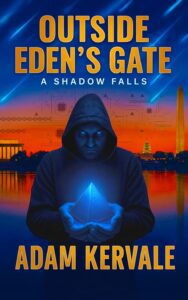
Today, Feathered Quill reviewer Alma Boucher is talking with Adam Kervale, author of Outside Eden's Gate: A Shadow Falls.
FQ: The title is intriguing. What does "Outside Eden's Gate" symbolize?
KERVALE: It references the infamous Gate of Eden; the mythical beginning of humankind in Abrahamic faiths and the subsequent Fall of Man. The idea of fallen angels is echoed in the subtitle, A Shadow Falls. One passage describes the gate as guarded by flaming swords moving back and forth. One interpretation of that image is that the moving swords are an ancient oral account of the Northern Lights, suggesting Eden lies somewhere to the north, but more importantly, something out of reach. In this book, Eden remains a magical place, but the central question is: which side of the gate are we on and who has the power to go through it? The world is beautiful, and it is what we make of it, are we already in Eden?
FQ: Why did you choose Ava as your central protagonist, and what qualities make her the right person to face the novel's challenges?
KERVALE: When I first started the book, the central characters were Theo and Kurt as brothers, which could have worked. As the author, however, I was more familiar with the dynamic between a male and female sibling, so that relationship felt stronger and served the story better. Choosing Ava as the protagonist also allowed for a more powerful confrontation with the antagonist and helped steer the novel toward a hopeful conclusion.
FQ: Your novel explores the intersection of technology, faith, and power. Why do these themes resonate with you?
KERVALE: Technology has been my life’s work, and I’ve watched it change dramatically. Lately we’ve seen powerful actors use technology to shape people’s psyches quickly, and many of those influenced are people of faith. The world used to move more slowly: we read a newspaper in the evening to learn what was happening. Then television arrived, and now news comes in small chunks—short paragraphs and video clips—not unlike verses of scripture. I incorporated that rhythm into the book: byte‑sized information packets followed by narrative and storytelling. Each chapter opens with a news sound bite, often tweets from the President in the novel, which set the tone for the power struggles surrounding the characters. The story also features a wealthy individual whose resources give him enormous influence.
FQ: Ancient prophecy plays a significant role in the novel. What drew you to incorporating fictional scripture into a modern thriller?
KERVALE: I’m drawn to mystery and the unknown, and prophecy introduces the compelling “what if.” It invites speculation and forces us to examine what we actually believe, whether those beliefs are more or less credible, and what we truly know. Prophecy exposes how many convictions are inherited or programmed rather than examined.
FQ: Ava and her brother approach the mystery from very different perspectives. What interested you about that dynamic?
KERVALE: This is a known phenomenon of two siblings who take very different paths in life. I enjoyed setting up a clash between evidence and prophecy, facts and hidden secrets, and watching those forces collide. That tension was part of the fun of writing the novel. We see similar dynamics in everyday life but often hesitate to admit that unseen forces might be at work. In that sense, the sibling contrast deepens the book’s mystery about what it means to be alive.
FQ: How do you create believable characters in such a high-stakes, fast-paced story?
KERVALE: I give readers glimpses into what characters are thinking, not just what they do. I expose their doubts and curiosities and let them think out loud at times. Those interior moments; small, honest reactions and conflicting impulses make characters feel real even when the plot moves quickly.
FQ: This is your debut novel. What was the biggest challenge in writing your first book?
KERVALE: I felt compelled to write this story. I began highly motivated and pushed past 50,000 words with only a vague idea of how the novel would fully unfold. I rewrote many sections before I could move beyond that point. Eventually, somehow, I reached the end. It was a real challenge, and I now have a new respect for every author who finishes a story.
FQ: The novel has been described as "chillingly relevant." Was that intentional from the beginning?
KERVALE: Yes. I wanted readers to think seriously about the power struggles shaping our world and to ask who is steering us toward outcomes that should be unacceptable to humanity. I also wanted the book to prompt a deeper question: is evil real, and are we witnessing its consequences? Those concerns about influence, responsibility, and moral consequence shaped the story from an early stage.
FQ: Is Outside Eden's Gate: A Shadow Falls intended as a standalone novel or the beginning of a series?
KERVALE: Another has been started, with some overlapping characters. It jumps back to the 90's for things that may happen in our future. So I guess that means it could be a series!
FQ: What do you hope readers are still thinking about days or even weeks after they finish Outside Eden's Gate: A Shadow Falls?
KERVALE: I want readers to keep asking what is happening around us and, more importantly, what we are going to do about it. I hope they consider who is best suited to lead that charge and what responsibilities we each bear in shaping the future. Those questions about awareness, action, and leadership should linger long after the last page.
Read the Review